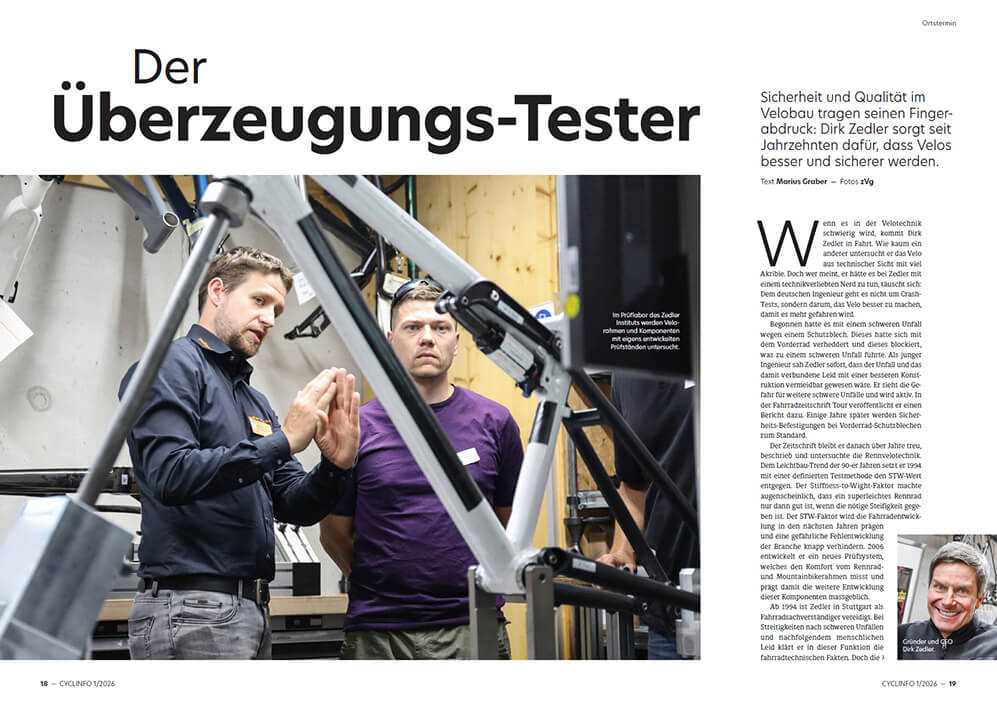
Whenever bicycle engineering becomes complex, Dirk Zedler comes into his own. Few analyze bicycles with such technical rigor and meticulous attention to detail. Yet anyone expecting a technology-obsessed nerd would be mistaken: the German engineer is not driven by crash testing for its own sake, but by the goal of improving bicycles so that more people ride them.
It all began with a serious accident caused by a mudguard. It became entangled with the front wheel, locking it and leading to a severe crash. As a young engineer, Zedler immediately recognized that both the accident and the resulting human suffering could have been avoided through better design. Seeing the risk of further serious incidents, he took action and published a report in the cycling magazine Tour. A few years later, safety release mechanisms for front mudguards became standard.
He remained committed to the magazine for many years, describing and analyzing road cycling technology. In response to the lightweight trend of the 1990s, he introduced the STW value (Stiffness-to-Weight factor) in 1994, based on a defined testing methodology. This metric made it clear that an ultra-light racing bike is only effective if it also provides sufficient stiffness. The STW factor went on to shape bicycle development in the following years and helped narrowly prevent a potentially dangerous industry trend. In 2006, he developed a new testing system to measure the comfort characteristics of road and mountain bike frames, significantly influencing the evolution of these components.
Since 1994, Zedler has been a sworn bicycle expert based in Stuttgart. In disputes following serious accidents and the resulting personal consequences, he clarifies the technical facts relating to bicycles. However, this work felt too retrospective to him. He became more interested in preventing such incidents and legal cases altogether. As a result, he began offering industrial testing services through his company, enabling structured testing and improvement of components and bicycles before they reach the market. What was initially unusual in the bicycle industry has since become standard practice among reputable manufacturers, who recognize that testing costs are far lower than the consequences of product failures.
Zedler also regularly conducts tests for magazines, always guided by a commitment to the bicycle itself. While other institutes may focus on destructive testing, he is driven by the ambition to improve the bicycle as a technical product – and to ensure that his testing systems realistically reflect real-world conditions. To this end, his entire team develops testing equipment that, where necessary, deviates from, supplements, or exceeds established testing standards. The rationale is that many standards define only minimum requirements, whereas real-world loads are often more complex and dynamic – for example, due to higher system weights in e-bikes or evolving urban usage patterns. Today, the testing laboratory comprises more than 80 dynamic testing systems covering virtually all bicycle components and types.
SUSTAINABILITY: CONSISTENT AND COMPREHENSIVE
In 2017, the Zedler-Institut moved into a purpose-built facility. Zedler’s straightforward approach is reflected in the building itself: extensive use of wood, separable construction materials, and top-tier insulation standards are complemented by the reuse of waste heat from compressors required to operate the testing systems. The new company building meets the highest sustainability criteria and has received multiple awards.
However, Zedler interprets sustainability more broadly. For him, it also encompasses corporate culture, social responsibility, and the training of future professionals. His company employs three apprentices, maintains educational partnerships with schools, and supports aspiring engineers completing project work. On the top floor of the building, Zedler has established a training center – his fourth business division – where he offers advanced training programs for product developers, technicians, and bicycle mechanics.
After many years and numerous initiatives, Zedler at times cannot conceal a certain disillusionment. This arises when companies fail to respond consistently to product defects, thereby accepting accidents and reputational damage for the industry. It also emerges in his work as an expert for insurers, where instances of minor and major fraud by otherwise ordinary individuals come to light. And it is reinforced by the observation that some major industry players show little to no commitment to the bicycle itself or its role in society and transportation. In this context, he rightly points to the imbalance between the level of engagement demonstrated by his relatively small company and that of large corporations. Indeed, the industry could learn from his passion for cycling.
THE ZEDLER-INSTITUT
Dirk Zedler founded his company in 1993 in Ludwigsburg (near Stuttgart), and it now employs around 30 people. The organization operates across four core business areas:
TESTING TECHNOLOGY AND -SERVICES Development of innovative, precise, and reliable testing systems for bicycles, e-bikes, and cargo bikes. These systems are used in the laboratories of bicycle manufacturers and cycling publications. The institute also provides testing services for bicycle and component manufacturers – from prototype validation through to series production testing.
TECHNICAL DOCUMENTATION Preparation of user-friendly and legally compliant operating manuals, development of risk assessments for manufacturers, and advisory services in the event of product recalls or market surveillance procedures.
EXPERTS REPORTS AND LOSS ANALYSES Preparation of up to 750 expert reports annually for courts, insurers, companies, and private individuals in cases involving accidents, defects, or theft. This work is supported by insights from the testing laboratory and an extensive archive of bicycle documentation spanning more than 30 years.
TRAINING AND WORKSHOPS Continuing education programs for retailers, mechanics, manufacturers, product developers, managers, and insurance professionals.
These four business areas complement and reinforce one another: insights gained in the testing laboratory form the basis for expert reports and consultancy work, while findings from expert analysis feed back into operating manuals and provide input for the development of testing procedures.
Author: Marius Gaber